Introduction of FTIR, ATR, Fiber Optics, and ATR Probes in Spectroscopy and Associated Designs - Part I
This article describes the basic principles of FTIR, Attenuated Total Reflection-Infrared Spectroscopy (ATR-IR), Fiber Optical Spectroscopy techniques and their applications in in-line reaction monitor and process control. The design and selection of fiber coupler, fiber optical cable and fiber probe are briefly introduced.
Contents Outline
1. Introduction of FTIR
1.1. What is FTIR?
1.2. Why Mid-Infrared?
1.3. What is ATR-IR
2. Introduction of Fiber Optics and ATR Probes
2.1. Why fiber optics?
2.2. How to select the ATR fiber optic probes?
3. Design of ATR Probe System
3.1. General design of ATR probes
3.2. ATR Crystals choice
3.3. Selection of Mid-IR Optical fibers
3.4. Fiber Probe Coupler to IR spectrometers
4. Benefits and Applications of Fiber Optics and ATR Probes
4.1. Benefits of Fiber Optic probes in Spectroscopy
4.2. Typical Applications of ATR Fiber Optic probes in Spectroscopy
1. Introduction of FTIR
1.1 What is FT-IR?
FT-IR (Fourier Transform InfraRed) is a preferred method of infrared spectroscopy. In infrared spectroscopy, IR radiation is passed through a sample. Some of the infrared radiation is absorbed by the sample and some of it is transmitted. The resulting spectrum represents the molecular absorption and transmission, creating a molecular fingerprint of the sample. Like a fingerprint, no two unique molecular structures produce the same infrared spectrum. This makes infrared spectroscopy useful for several types of analysis.
1.2 Why mid-Infrared?
Infrared spectroscopy has been used to analyze materials since the middle of the last century. The infrared spectrum of the material is similar to a fingerprint with absorption peaks that correspond to vibrational frequencies between the bonds of the atoms that make up the material.
Since each individual material is a unique combination of atoms, no two compounds give the same infrared spectrum. Therefore, infrared spectroscopy can lead to identification (qualitative analysis) of all types of materials. In addition, the peak size in the spectrum is a direct indicator of the amount of material presented. Thanks to modern software, infrared spectroscopy becomes an excellent tool for quantitative analysis.
As shown an IR spectrum of acetone in Figure 1, the most intensive fundamental vibrational absorption bands are mainly present in so-called “finger-print range” which is the field of mid-IR spectroscopy. Near-infrared spectroscopy deals with weak overtones of the fundamental bands and needs, therefore, much longer optical path in medium to get informative spectrum – up to 20mm vs 5-50µm optical path in mid-IR range.
Figure 1 IR spectrum of Acetone
1.3 What is Attenuated total reflection (ATR)?
ATR is one of the most popular sampling techniques used in conjunction with infrared spectroscopy. Samples can be directly examined in the solid or liquid state without further preparation.
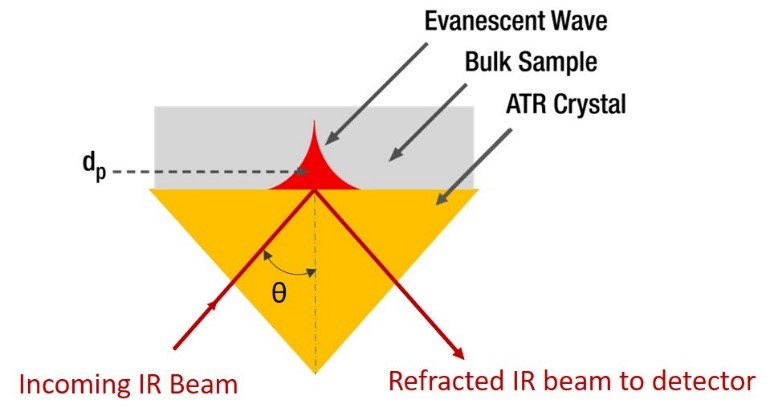
An ATR accessory operates by measuring the changes that occur in an internally reflected IR beam when the beam comes into contact with a sample. As shown in Figure 2, an IR beam is directed onto an optically dense crystal with a high refractive index at a certain angle. This internal reflectance creates an evanescent wave that extends beyond the surface of the crystal into the sample held in contact with the crystal. The penetration depth is typically in an order of a few microns (ca. 0.5-3 um), depending on the wavelength, the refractive indices of the ATR crystal, the sample and the angle of the entering light beam.
Figure 2 Working Scheme of attenuated total reflection
In regions of the IR spectrum where the sample absorbs energy, the evanescent wave will be attenuated. The attenuated beam returns and exits the crystal and is directed to the detector in the IR spectrometer. The detector records the attenuated IR beam as an interferogram signal, which can then be used to generate an IR spectrum.
The major benefit of ATR is the ability to measure a wide variety of solid and liquid samples with minimum sample preparation. It also enables the sample test in aqueous solution by eliminated the interference from water absorption by subtracting the water background.
2. Introduction of Fiber Optics and ATR Probes
2.1 Why Fiber Optics?
Before the introduction of fiber optics, spectroscopy instruments are designed with bulky optical benches and light tight seal. Sample are prepared and placed in the sample chamber for analysis. The use of fiber optics in modern spectroscopy not only change the way optical instruments are designed but also opens many new opportunities for novel measurement techniques and analytical applications. Fiber optic cables are flexible and enable ones to easily control and confine the optical signals from light source to sample and then to the detector. One of the key applications is to integrate the flexible fiber optical cable with a miniaturized probe. It enables a remote spectroscopy in-situ and real time to see all key spectral bands with no need of sample preparation.
Fiber optics have been used in the spectroscopy analysis in UV-Vis, Near infrared (NIR), Raman and fluorescence. We offer a variety of fiber optic probes in these fields as shown in Figure 3.

Figure 3 Fiber optic probes for UV-Vis, NIR, Raman and ATR
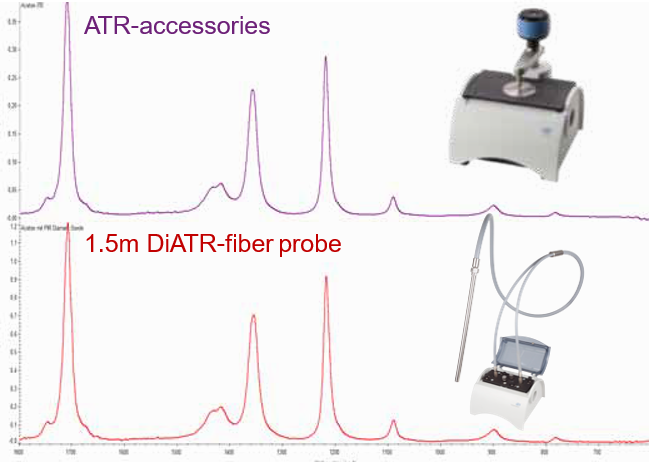
Fiber optic probes can produce high quality spectra as the bench top accessories. For example, Figure 4 shows no significant difference is between liquid sample on ATR accessory in FTIR spectrometer and spectrum measured with fiber optic ATR probe coupled with the same spectrometer.
Figure 4 Spectra of Acetone collected by ATR and ATR fiber probe
2.2 How to Choose the right ATR Probes?
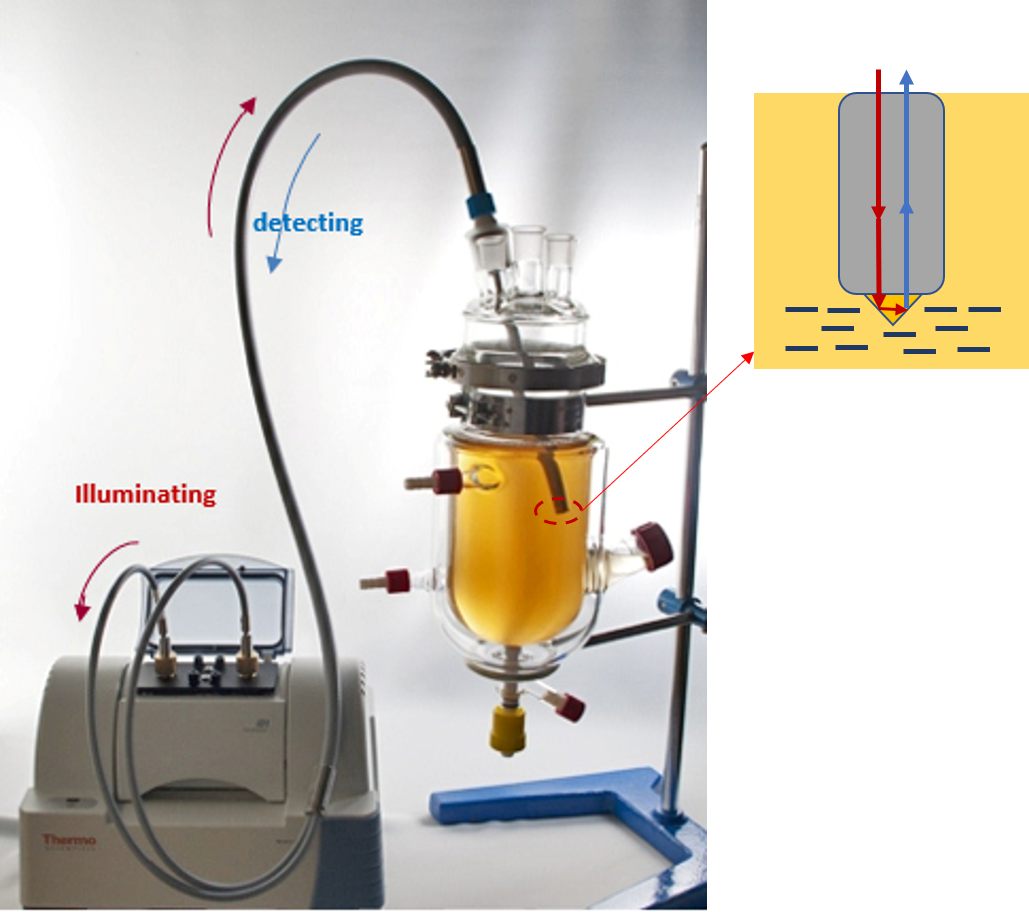
The first and most important thing in FTIR analysis is to choose the right type of the ATR fiber probe. Usually the nature of the sample and working environments determines the selection of the best probe type. The working principle is illustrated in Figure 5. Regardless of the fiber probe, light from FT-IR analyzer is guided by the optical fiber probe on the surface of solid sample or diving into the fluid sample. The light with sample spectra is captured by a fiber optical detection line and returned to the analyzer where the data is analyzed and post-processed.
Figure 5 ATR fiber optic probe System