
Introduction of Programmable Spin Coater
A programmable spin coater is a laboratory instrument used in the deposition of thin films onto substrates through a process called spin coating. Spin coating is a widely used technique in the fields of material science and microfabrication to create thin and uniform films of various materials, such as polymers, metals, and ceramics, on a substrate.
Working Principle
The basic working principle of a spin coater involves the following steps:
- Substrate Preparation: A substrate, usually a flat and solid surface (e.g., silicon wafer or glass slide), is placed on the spin coater chuck.
- Application of Coating Solution: A small amount of liquid coating solution containing the material to be deposited is dispensed onto the center of the substrate.
- Spinning: The substrate and coating solution are spun at high speeds. The rotation causes centrifugal forces that spread the liquid over the substrate's surface, creating a thin, uniform film.
- Evaporation: While spinning, the solvent in the coating solution begins to evaporate. This process continues until a solid thin film is left on the substrate.
- Drying: After spinning, the coated substrate is allowed to dry thoroughly to remove any remaining solvent.
Components of a Programmable Spin Coater
A programmable spin coater typically consists of the following components:
- Chuck: The platform where the substrate is placed.
- Spindle: The motorized arm that spins the chuck.
- Programmable Controller: Allows the user to set and control the spin speed, acceleration, and duration.
- Dispensing System: For controlled application of the coating solution.
Typical Applications:
- Photovoltaics: Spin coating is used to deposit thin films of materials for solar cell applications.
- Microelectronics: In the fabrication of integrated circuits and semiconductor devices.
- Sensors: Creating thin film layers for various sensor applications.

Related Articles

Vacuum Pressure Conversion Charts (Absolute and Relative)
Perfect vacuum or 100% vacuum is a zero reference pressure. In practice, a perfect vacuum is impossible to obtain. The two tables below are for reference only when selecting vacuum pump related products. It is the sole responsibility of users who uses these tables to select their products. Any improper selection or use of the table may cause any damage or injury. Please consult with your own subject matter expert for advice on how to select appropriate vacuum. Vacuum Pressure Unit Conversion Chart (Absolute) and Vacuum Pressure Unit Conversion Chart (Gauge) are plotted for reference.
Related Products
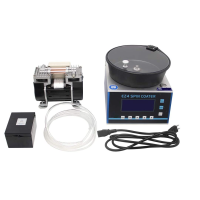
Laboratory Programmable Compact Spin Coater EZ4S Model Including Oil-Free Vacuum Pump, 110/230VAC
This product is a cost-effective compact size vacuum spin coater designed for precise and uniform de..
$2,498.00

Vacuum Pump ASP-550VT Oil-Free for Spin Coater, Maximum Vacuum 24.8 inHg
This vacuum pump features compact size, light weight and high flow performance. It carrie..
$599.00

Laboratory Compact Hot Plate ASP-HP10 for Photolithography
ASP-HP10 is a compact and easy-to-use hot plate designed for general lab uses, especially for photol..
$2,018.00