
Laboratory Vacuum Filtration System Introduction
The Laboratory Vacuum Filtration System emerges as a versatile and indispensable tool, excelling in precise separation and filtration processes. Operating on the principle of creating a pressure differential across the filter medium by evacuating the air beneath it, this innovative system significantly enhances filtration rates. Intricately designed, the vacuum filtration system optimizes procedures for isolating solids from liquid samples, separating precipitates from solutions, and preparing samples for comprehensive analyses.
A typical vacuum filtration system comprises the following components:
- Filter flask: Collects the liquid that passes through the filter paper.
- Büchner funnel: Securely retains the filter paper, accumulating solids while permitting liquid passage.
- Filter paper: Separates solids from unsaturated solutions.
- Vacuum source: Provides necessary suction for the filtration process (usually a vacuum pump).
- Conical seal: Maintains the desired vacuum pressure inside the Büchner flask.
- Connection tubing: Connects the Büchner flask and vacuum source.
- Water trap: Prevents backflow and corrosive evaporation into the pump.

After setting up the vacuum filtration apparatus and ensuring secure connections, the filtration procedure involves:
- Selecting suitable filter paper.
- Cutting it to size.
- Positioning it in the funnel.
- Pouring a sufficient amount of solvent onto the filter paper to ensure full saturation.
- Setting the vacuum pressure by activating the vacuum pump and reading the vacuum gauge.
- Adjusting the vacuum pressure to the desired level.
- Collecting the filtered liquids.
- Collecting the filtrate: The liquid passing through the filter paper is called the filtrate, drawn into the clean flask under the filter flask by the vacuum.
- Washing and drying the solid to obtain the final products.
- Cleaning the apparatus: Disassemble the filtration apparatus, dispose of filter paper and solids properly.
Common issues in vacuum filtration include air leaks, liquid leakage, filter breakage, clogging, tearing of filter paper, drying out, low filtration rate, inconsistent performance, and foaming. Quick troubleshooting steps include checking the correct setup, ensuring proper vacuum pump connection, using the right filter paper, rinsing solids after filtration, monitoring vacuum pressure, and replacing the paper filter as needed.
Various types of vacuum filtration manifolds with borosilicate glass or stainless steel 316 funnels are available, ranging from single to six-branch versions, enhancing working efficiency. Multiple glass or stainless steel funnels can work simultaneously, providing flexibility and scalability.

Related Articles

Laboratory Vacuum Filtration Apparatus Basics
Vacuum filtration is a critical technique applied in laboratories and industrial processes for the separation of solids from liquids through the use of reduced pressure. Widely utilized in fields such as chemistry, biology, the pharmaceutical industry, and environmental analysis, this method efficiently removes particles, clarifies solutions, and isolates precipitates or solid residues. Also known as negative pressure filtration, its fundamental principle involves creating negative pressure beneath the membrane, leveraging the pressure differential to accelerate liquid flow and achieve effective solid-liquid separation. A typical vacuum filtration setup includes the following components.

Vacuum Pressure Conversion Charts (Absolute and Relative)
Perfect vacuum or 100% vacuum is a zero reference pressure. In practice, a perfect vacuum is impossible to obtain. The two tables below are for reference only when selecting vacuum pump related products. It is the sole responsibility of users who uses these tables to select their products. Any improper selection or use of the table may cause any damage or injury. Please consult with your own subject matter expert for advice on how to select appropriate vacuum. Vacuum Pressure Unit Conversion Chart (Absolute) and Vacuum Pressure Unit Conversion Chart (Gauge) are plotted for reference.
Related Products
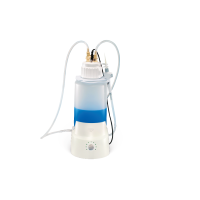
SAFEVC Vacuum Aspiration System- 4L Volume
This product is designed for laboratory waste recovery and separation of liquid and solid. It featur..
$773.00 $858.90

Vacuum Filtration Manifold (Filter Integrated Type), 1-Branch, 3-Branch, and 6-Branch, Stainless Steel 316 Funnel with Filter Size 100um
The vacuum filtration manifolds consists of lid (SS316), funnel (SS316), sieve plate (SS316), ..
$529.00

Laboratory Stainless Steel 316 Vacuum Filtration System, Including Vacuum Pump, Vacuum Manifold, Receiving Bottle and Vacuum Trap
Laboratory vacuum filtration finds widespread application in tasks such as the separation of precipi..
$1,367.12
Tags Sample Preparation, Vacuum Filtration, Reagent Injection, Cell Culture, Synthetic Biochemistry