
Peristaltic Pump Tubing Selection Guide
Peristaltic pumps are typically used to pump sterile or aggressive fluids without exposing those fluids to contamination from exposed pump components. They are self-priming, reversible and highly reliable. Also, peristaltic pumps are suitable for applications where isolation of the product from environment is critical, such as pumping abrasives, corrosive or/and viscous fluids. There are a wide variety of applications of peristaltic pumps listed but not limited:
- Medicine: Dialysis machine/medical infusion pumps, blood transfusion
- Testing and research: Auto-analyzer , analytical chemistry experiments, media dispensers
- Chemical handling: Pharmaceutical production, dosing systems
- Food manufacturing: beverage dispensing
- Aquarium water supply, sewage handling
Tubing Selection Consideration
The pump tubing isolates the fluid from the rest of the pump and environment and makes it ideal for handling aggressive, corrosive media and those shear-sensitive fluids (for example, particle-laden fluids etc.). Thus, it is important not to neglect the selection of the pump tubing. There are several primary factors that should be considered in this selection process.
- Chemical compatibility
- Maximum pressure
- Operating temperature
- Dimension
- Regulations
- Life expectancy
- Gas permeability
- Sterilization methods
- Cost
Chemical compatibility – The delivered fluid of a peristaltic pump only comes into contact with the pump tubing. Thus, tubing should have good chemical characteristics, such as low absorption, good temperature resistance, no swelling and anti-corrosion etc. End users should test the tubing under actual conditions to determine its resistance to corrosion.
Temperature – the working temperature range of a tubing is another important specification to be considered. Before selecting a tubing, end users should identify both the min and max temperatures possible in the system. As far as the tubing materials, silicone has a relatively broad temperature range, for example, the Bio-Silicone™ tubing can work from -35℃ to 200℃. In some applications, tubing material needs to be autoclaved for sanitation purposes. Thus, the maximum working temperature of tubing should be higher than autoclave temperature.
Pressure - the tubing must be able to withstand the system pressure without leakage or failure. It must also be able to adequately handle abrasive media and suspended particulates. High pressure causes tubing swelling and thus results in improper fit through the pump head. Working temperature also may impact the maximum pressure of the tubing. For example, when the pump used in a process with increased temperatures, the working pressure for a given tubing ID will decrease.
Size -Tubing is an essential part of the design of a good-quality peristaltic pump and must be correctly selected to fit within the pump head to ensure consistent and repeatable flow performance. The inner diameter and wall thickness must be taken into account because the inner diameter of the tubing determines the amount of fluid dispensed and the wall thickness affects the fitment of the tubing side the pump head. Small tubing cannot be well retained inside the pump head and leads to insufficient flow or complete failure. On the other hand, excess material of large tubing causes excessive wear and potential occlusion.
Regulatory approval - for some applications, such in pharmaceutical industry, the peristaltic pump tubing used must meet and conform to certain standards and regulations, such as United States Pharmacopoeia (USP), European Pharmacopoeia (EP), U.S. Food and Drug Administration (FDA), U.S. Department of Agriculture (USDA) and National Sanitation Foundation (NSF).
Tubing Life expectancy – Different tubing materials have different capability to withstand the repeated squeezing action of rollers. Tubing size and material, pump head type and rotor speed, working temperature and discharge pressure all impact the life expectancy of tubing. Due to the inherent characteristic of peristaltic pump, tubing needs to be replaced after certain operation period to ensure the desired flow rate. Pump tubing manufacturers should be able to provide test data on the tubing life expectancy.
Gas permeability - for those applications where the media must be isolated from gases, the tubing material must have an acceptably low gas permeability rating
Cost – End users must work with tubing manufacturers or pump suppliers to select the best tubing for their peristaltic pumps after identifying the product requirements. Also, another important consideration is the tubing replacement cost and downtime.
Common Tubing Specification
- Micro and small flow tubing

- Medium flow tubing

- Industrial/large flow tubing

- Step 1 Pump drive selection ( for example: L100-1FS RFID feature)
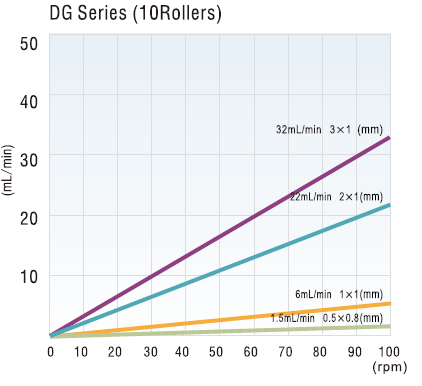
- Step 2 Pump head selection (DG series 10 rollers)
- Step 3 Tubing selection


Related Articles

Approaches to reduce flow pulsation on peristaltic pumps and working principles
Peristaltic pumps inherit with flow pulsation as a natural result of the way in which the pump operates by compressing the tubing. There are several approaches that can be used to reduce flow pulsation in peristaltic pumps. The principles behind these approaches to reducing flow pulsation in peristaltic pumps involve minimizing the amount of disruption to the flow of the fluid and allowing the fluid to pass through the pump smoothly and evenly. A few commonly used methods are discussed herein.

Peristaltic pump selection guide and tips, applications
A peristaltic pump is a type of mechanical pump that uses rotating rollers to compress and move a flexible tube or hose, which creates suction and propels the liquid or fluid contained in the hose. This type of pump is commonly used in a variety of industries due to its ability to handle delicate and viscous fluids, as well as its ability to operate in a variety of conditions and environments.

Background Introduction to the Role of Peristaltic Pumps in Spectrometers and Spectroscopy
Spectrometers and spectroscopy represent pivotal tools in analytical chemistry, offering insights into the composition, structure, and properties of substances through the interaction of matter with electromagnetic radiation. These techniques have found applications across diverse scientific disciplines, including chemistry, physics, biology, medicine, and environmental science. The accuracy and reliability of data obtained through spectrometric analyses depend not only on the sensitivity of the instruments but also on precise fluid handling during the analytical process.

How to Calibrate the Flow Rate of a Peristaltic Metering Pump?
For a specific ID tubing with a certain length, the flow rate of peristaltic pump is proportional to the pump drive speed (RPM) within the linear region of its operation. The actual flow of a peristaltic pump depends on many factors, such as the fluidics properties (viscosity), the way the tubing installation, system hydraulic resistance (fitting, tubing flow resistance), the tubing stiffness and operation time as well fluid temperature. These factors cannot be accounted during factory testing and calibration. The flow rate even changes a little bit after tubing burn-in (first 1-2 hours operation). One can easily notice that the flow rate of a peristaltic pump gets attenuated. Calibrating a peristaltic pump becomes necessarily to ensure accurate dispensing of liquids. The steps can vary based on the specific model and features of your peristaltic pump, but here are general guidelines for calibrating a peristaltic pump with a calibration function.

How to Run Preventive Maintenance on Peristaltic Pump Tubing to Extend its Life
Preventive maintenance is crucial to extend the life of peristaltic pump tubing and ensure optimal performance. Here are some general steps you can take to maintain peristaltic pump tubing: Regular inspection, Replace tubing regularly, Proper tubing material selection, Clean the pump head, flush the tubing, Avoid dry running, Maintain proper tubing compression, Monitor pump performance, Train operators, Documentation and Environmental considerations.

Peristaltic Metering Pump Types and Their Working Modes
One of the key advantages of peristaltic pumps is their ability to handle delicate and viscous fluids without damaging them. Unlike other types of pumps, the flexible tubing used in peristaltic pumps does not come into contact with the fluid, which means that there is no risk of the fluid being damaged or contaminated. Peristaltic pumps are also known for their reliability and durability. They are simple in design and have few moving parts, which means that they require minimal maintenance and have a long lifespan. They are also able to operate in a wide range of temperatures and environments, making them suitable for use in a variety of industries.
Related Products
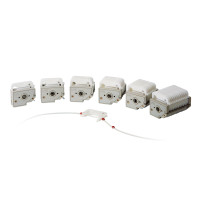
Peristaltic Pump Head, Low Flow Rate ≤48 mL/min, Cartridge Type, DG Series
The LP-DG series pump heads are designed for low flow rates (up to 48 mL/min) and multi-channel..
$248.00

Peristaltic Pump, Flow Rate 150 nL/min - 500 mL/min, Max 8 Channels, Keyboard Control, L100-1S-1
This multi-channel Peristaltic Pump (L100-1S-1) can generate adjustable flow rates in the ran..
$685.00

Intelligent Peristaltic Pumps L100-1F , Flow Rate 0.15µL/min - 500 mL/min
This intelligent peristaltic pump L100-1F can generate adjustable flow rates in the range ..
$1,725.75
Tags Tubing