
Empty FPLC Columns Threaded-End|MXK Low-Pressure Series
A technical guide to empty FPLC columns covering pressure ratings, materials, frit specifications, packing methods, and best practices for protein and antibody purification workflows, with verified specifications from leading suppliers.
Empty FPLC columns give chromatography users complete control over resin selection, bed geometry, and packing quality — control that pre-packed columns do not offer. Because the hardware is decoupled from the stationary phase, researchers can match a single column format to affinity, ion-exchange, size-exclusion, or mixed-mode media simply by changing the resin. This flexibility makes empty columns the standard choice for method development, resin screening, scale-up studies, and custom purification workflows.
Fast Protein Liquid Chromatography (FPLC) is a low-pressure liquid chromatography technique optimized for purifying proteins, antibodies, peptides, enzymes, and other biomolecules under conditions gentle enough to preserve biological activity and native structure. Typical FPLC buffer pressure is kept under 5 bar (0.5 MPa), well below the pressures used in HPLC — which is what makes it suitable for soft, compressible agarose- and dextran-based resins. Column hardware is rated with additional safety margin above this operating pressure, allowing for repeated use and higher-flow applications.
Because packing is performed by the end user, empty columns are the standard format for method development, process optimization, resin screening, and custom workflows that pre-packed columns cannot accommodate. They connect directly to GE ÄKTA purifiers and comparable FPLC systems, peristaltic pumps, and syringe-driven setups.
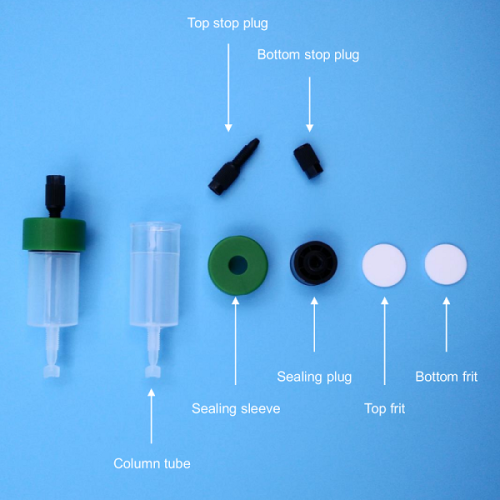
Note: Threaded-end columns (MPPC001 series) require the matching FPLC Column Assembly Tool, sold separately, for packing and sealing.
Key Features
- Direct connection with GE ÄKTA purifiers
- Extremely low non-specific binding
- Pack any resin chemistry — affinity, ion-exchange, size-exclusion, or mixed-mode — into the same column body
- Threaded-end design available for enhanced pressure resistance and superior sealing (up to 0.65 MPa / 6.5 bar / 94 psi)
- Dedicated assembly tool (1 mL or 5 mL, ordered separately) ensures proper packing and seal integrity on threaded-end columns
- MXK series scales from 5 mL analytical volumes up to 1,862 mL preparative columns
- Borosilicate glass MXK columns feature a thermostatic jacket for temperature control (4–60°C) and chemical resistance across pH 1–14
- Reusable hardware — store packed columns for repeated purification runs
Key Specifications to Evaluate
Column Volume and Bed Geometry
Column volume, set by internal diameter and usable bed height, determines sample loading capacity. As a general guideline, bind-and-elute modes such as affinity and ion-exchange chromatography tolerate short, wide beds because resolution depends more on binding capacity than on plate count, while size-exclusion chromatography (SEC) is diffusion-limited and benefits from longer, narrower beds. Exact ratios vary by resin — always check the resin manufacturer's packing guide before committing to a bed geometry.
Pressure Rating and Column Material
Polypropylene columns are the most common format for routine work, with rated maximums ranging from about 3–7 bar (44–100 psi) for standard designs up to roughly 14 bar (200 psi / 1.38 MPa) for reinforced designs. Threaded-end polypropylene columns push this further — up to >6.5 bar (94 psi / 0.65 MPa) — specifically to improve seal integrity under repeated use. Borosilicate glass columns with stainless-steel end fittings are rated up to 60 bar (900 psi / 6 MPa) and add the benefit of visual bed inspection for detecting channeling, cracking, or air entrapment. Material selection also affects chemical compatibility: polypropylene resists most aqueous buffers, chaotropes, and moderate organic solvent concentrations, while glass and stainless steel tolerate more aggressive clean-in-place (CIP) protocols.
Frit Design and Pore Size
Frits — porous discs at the top and bottom of the bed — retain the resin while allowing mobile phase to pass. Frit pore size must be smaller than the resin's mean bead diameter to prevent media loss and bed disruption, but not so fine that it creates excessive back-pressure. A 10–30 µm range suits typical agarose resins with bead diameters in the tens of microns; finer frits are used with smaller-particle silica or polymeric media.
Instrument and Fitting Compatibility
End fittings should match the tubing and connector standard of the target system — commonly 1/16″ OD tubing with 10-32 UNF or manufacturer-specific fittings for ÄKTA and similar FPLC platforms, or Luer connections for peristaltic-pump and syringe-driven setups. An adjustable flow adaptor (rather than a fixed top frit) allows the bed height to be fine-tuned as resin settles or compresses, helping maintain packing quality and reproducible retention times over the life of the column.
Column Packing: Methods and Quality Control
Packing quality has a direct, measurable effect on resolution and reproducibility. Column efficiency should be checked at regular intervals by calculating the asymmetry factor and plate count from a small-molecule tracer injection. Two packing approaches are used depending on resin type and column scale:
- Slurry (static) packing: resin is suspended in buffer and poured into the column in one continuous, bubble-free pour, then allowed to settle under gravity or light pressure before the adaptor is set. Suitable for most soft gel resins in research-scale columns.
- Flow (dynamic) packing: buffer is pumped through the settling bed at a controlled, gradually increasing flow rate to consolidate the bed under hydrodynamic pressure, producing more reproducible packing for larger-diameter or process-scale columns.
A typical packing procedure for a research-scale empty FPLC column follows this sequence:
- Degas and equilibrate both the resin slurry and packing buffer to remove dissolved gas that could form bubbles during compression.
- Wet the lower frit and install it, ensuring no trapped air remains at the frit surface.
- Pour the resin slurry in a single continuous stream down the column wall to minimize turbulence and layering.
- Allow the bed to settle (or apply controlled flow packing), monitoring for a level, bubble-free bed surface.
- Position the upper frit or flow adaptor per the resin manufacturer's recommended compression factor.
- Seal the column and equilibrate with several column volumes of running buffer at the intended operating flow rate.
- Validate packing quality with a tracer injection before committing to a purification run.
Typical Applications
- Purification of tagged proteins from bacterial, insect, and mammalian cell sources
- Antibody and recombinant protein capture, intermediate, and polishing steps
- Desalting and buffer exchange for nucleic acids, peptides, and proteins
- Ion-exchange and affinity-based charge or ligand-specific separations
- Size-exclusion chromatography for separation by molecular size
- Hydrophobic interaction and mixed-mode chromatography for challenging impurity profiles
- Nucleic acid purification — anion-exchange and affinity media for plasmid DNA, RNA, and oligonucleotide isolation
Best Practices for Long-Term Performance
- Degas all buffers before use, and prime lines fully before connecting to the column to avoid introducing air into the bed.
- Never exceed the column's rated maximum pressure — check both the column and resin manufacturer specifications, since the lower of the two governs the safe operating limit.
- Do not allow packed resin to run dry; store columns capped with a small volume of buffer or an appropriate storage solution (commonly 20% ethanol for agarose-based media).
- Monitor system back-pressure continuously; a gradual, sustained rise typically indicates fouling, while a sudden increase suggests channeling or frit blockage.
- Re-validate packing quality after any change in flow rate, buffer viscosity, or extended storage.
- Follow resin-specific CIP protocols on a regular schedule to remove precipitated proteins, lipids, and other foulants.
| P/N | Specification | Max Pressure | Quantity |
|---|---|---|---|
| MPPC001-8 | 1 mL Empty FPLC Column, Threaded End, Green Sealing Sleeve | >0.65 MPa (6.5 bar / 94 psi) | 50/Box |
| 009808-1 | 1 mL FPLC Column Assembly Tool (Order Separately) | — | 1/PK |
| 009808-5 | 5 mL FPLC Column Assembly Tool (Order Separately) | — | 1/PK |
| MXK16-20 | 16/200 mm, Volume 5–31 mL, Bed Height 2.5–15.5 cm | 7 bar | — |
| MXK26-40 | 26/400 mm, Volume 122–186 mL, Bed Height 23–35 cm | 7 bar | — |
| MXK50-100 | 50/1000 mm, Volume 1,588–1,862 mL, Bed Height 81–95 cm | 7 bar | — |
Full MXK series (16, 26, and 50 mm I.D. across 200–1000 mm lengths) and packing reservoirs (M16, M26, M50) available — contact our team for the complete configuration list.
Quick Selection Reference
| Parameter | Why It Matters | Typical Range |
|---|---|---|
| Column Volume | Sets sample loading capacity and scale | 1–5 mL (research); up to ~1,862 mL (process) |
| Max. Operating Pressure | Limits achievable flow rate and constrains resin selection | Polypropylene: 3–14 bar (0.3–1.4 MPa); glass/stainless: up to 60 bar (6 MPa) |
| Column Material | Determines chemical compatibility, pressure tolerance, and optical clarity | Polypropylene (routine IEX/AC); borosilicate glass (visual inspection, higher pressure) |
| Frit Pore Size | Retains resin bed while minimizing flow resistance | 10–30 µm for typical agarose resins |
| Bed Height : Diameter Ratio | Affects resolution and packing reproducibility | SEC: longer/narrower beds; IEX/AC: shorter/wider beds |
| Adapter/Piston Type | Enables bed compression and adjustment as resin settles | Fixed frit or adjustable flow adaptor |
| End-Fitting Connections | Determines instrument compatibility | 1/16″ tubing, 10-32 UNF, Luer, or proprietary FPLC fittings |
Conclusion
Empty FPLC columns remain the most flexible option for chromatography workflows that require custom resin selection, method development, or multi-mode purification on a single hardware platform. Matching column volume, pressure rating, material, and frit specification to the intended resin and separation mode — and following a validated packing and QC procedure — is what ultimately determines resolution, reproducibility, and column lifetime in the finished process.
Related Products

Custom-Built Class 100 Clean Glove Box
The Nichwell gloveboxes are complete standalone systems integrated with entire functional components..
$0.00

Bluewhite Flex-Pro Peristaltic Metering Pump A2V Deluxe Controls
Flex-Pro A3 Series Peristaltic Pump for high pressure and high accuracy applications. It does ..
$3,253.95

Industrial Peristaltic Metering Pump HP300 Series, High Flow Rate 28.5L/min, IP67 Waterproof
The industrial peristaltic metering pump HP300 series is specially designed for operation in harsh i..
$7,790.00

Industrial Peristaltic Metering Pump, Max Flow Rate 3250mL/min, IP66 Rating, G600-1L
The industrial peristaltic metering pump (G600-1L), an upgraded model from G600-1J, offers adjustabl..
$1,846.30
Tags Consumable, FPLC, Empty FPLC Columns, Chromatography, Chromatography Columns